14 Claude Code Workflows Worth Stealing & a Weekend Build to Prod — Claude Sydney Meetup — April 21, 2026
14 Claude Code Workflows Worth Stealing & a Weekend Build to Prod
TL;DR
- Start with a scope-killer (Hermes / office-hours skill) before any coder touches the project.
- Match the tool to the stage — Claude Code is a coder, not an architect. Use the superpowers skill chain for specs and plans.
- Always get a second model to review your plan. Codex catches what Claude rationalizes.
- "Tests pass" ≠ "prod works". Env vars, secrets, and integrations live outside your repo.
- Make prod errors observable: wrap every external call in try/catch, log with a tag.
On Tuesday, April 21, 2026, the 02Ship community gathered at Haymarket HQ (Level 2, 63 Dixon St) for our third Claude Sydney meetup. 50+ builders, engineers, and founders showed up for two longer talks and six community lightning talks — all focused on how people actually use Claude Code at work.
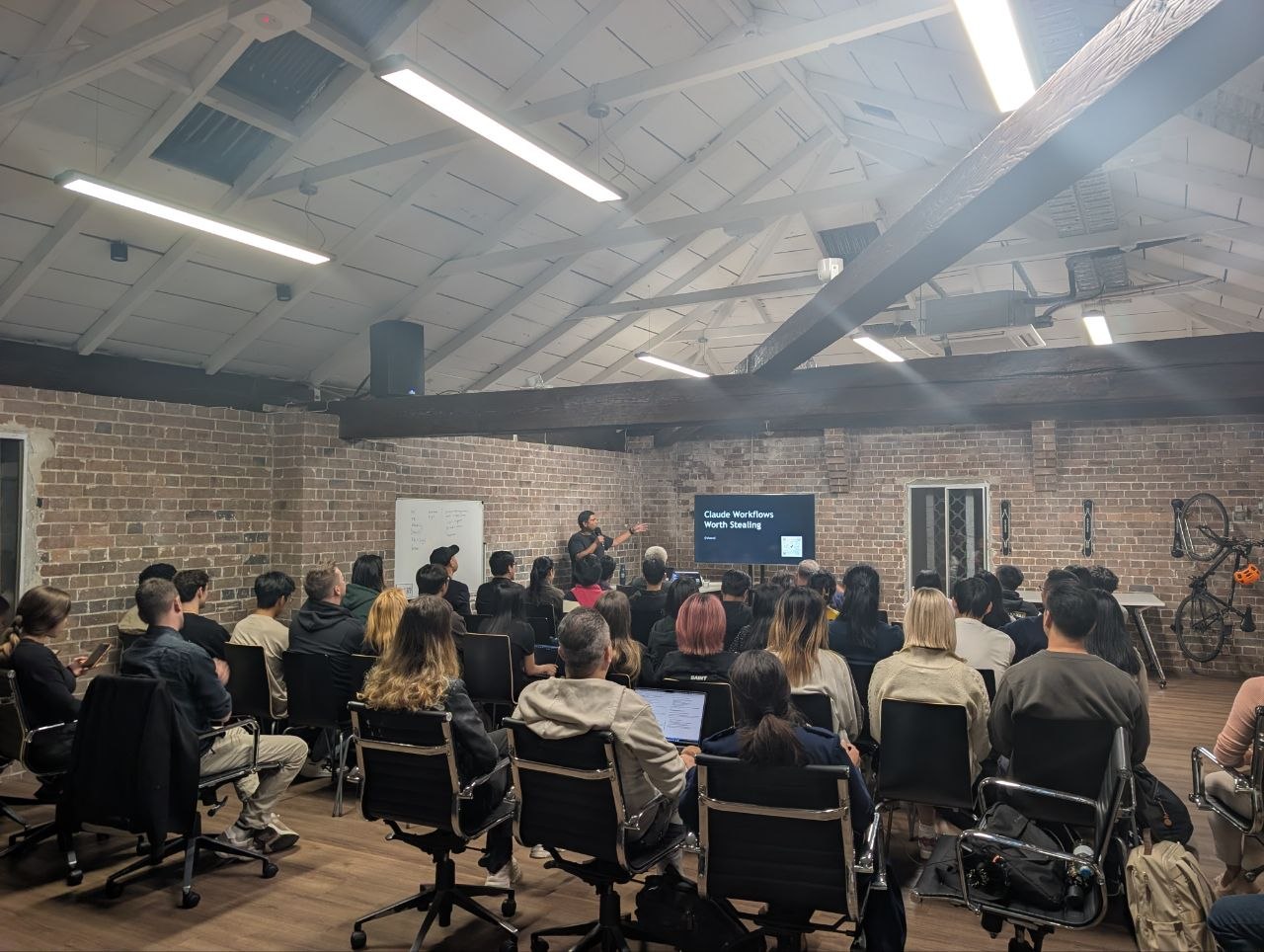
Thanks to Haymarket HQ for hosting the space and to everyone who turned up on a rainy Tuesday night.
The event page is here: Claude Sydney Meetup — How People Actually Use Claude Code at Work.
Talk 1: Claude Workflows Worth Stealing
Shaon Diwakar — Founder of Dini Labs, ex-Meta (Instagram/Threads), NewsMaven, Tyro, EY — opened with a rapid-fire tour through 14 Claude workflows that have made it into his daily practice. His framing: these are all "worth stealing" — pick the ones that match your stack.
We'll group the 14 workflows into four clusters so you can scan them fast.
Cluster 1 — Agent infrastructure
- InboxAPI — Shaon's own project. Gives every AI agent a personal email address so it can send and receive mail like any other teammate.
npm install -g @inboxapi/cliwith SMTP exposed via MCP. - Beads — local-first, SQLite-backed task tracker that lets an agent remember its own work. Issues store as JSONL for git collaboration; the agent picks up "ready" work and manages dependencies. Fixes the problem of Claude drifting off plan between sessions.
- Tool Gateways (Composio, Merge) — SaaS orchestration with 1,000+ pre-built integrations (Slack, GitHub, Jira, etc.). Managed OAuth, ephemeral sandboxes, and dynamic tool resolution. Skip building MCP servers per integration — buy the platform instead.
Cluster 2 — Agent behavior & knowledge
- Agent Skills ecosystem — "Baking engineering culture into agent memory." 20+ production-grade workflows covering TDD, security, and code quality. Shaon quoted the "Beyoncé Rule" — "If you liked the code, you should have put a test on it." Reference: Addy Osmani's Agent Skills on GitHub.
- Evals, Evals, Evals — Make the model rate its own work against a rubric before it calls a task done. Structured JSON self-evals documenting what went well, what needed improvement, what's next. Turns a solo dev into a team by enforcing guardrails.
- The LLM Wiki Pattern — a compounding knowledge base the agent contributes to. Markdown files in a shared git repo; agents read wiki-first before scanning raw source. Cuts token cost and stops the model from re-deriving the same facts every session. (Nod to Andrej Karpathy.)
- Requirements Interrogation — the "Interview me until you're 95% confident" prompt. Flip the dynamic: let Claude ask you the questions before any code is written. Surfaces hidden assumptions stakeholders didn't even know they had. (Addy Osmani again.)
Cluster 3 — Day-to-day dev workflows
- Claude Postgres Optimization — point Claude Code at a
psqlconnection (or an anonymized prod replica via MCP). Get slow-query reports, normalization gaps, and schema drift flagged before your users find them. - Headless Browser Ops — Playwright + Chrome DevTools MCP for frontend debugging. Real DOM interaction, network traces, console logs, performance profiling — the agent sees what the browser sees.
- Log Detective — read-only access to prod logs + DB schema. Claude correlates a stack trace back to a specific source line, proposes a fix, and verifies against the real failure data. Works with nginx, IIS, Apache. Shaon suggested Opus 4.6 for cost efficiency on long log tails.
- Security Auditor — agents review PRs for security and architectural drift. Self-eval against OWASP Top 10 before a commit lands. Web-search enabled so it can flag supply-chain attacks against your dependencies.
Cluster 4 — Meta & ergonomics
- Measure AI ROI — build leaderboards comparing AI-assisted output to the human baseline. If you can't show the saving, you can't get organizational buy-in.
- Voice Typing — 3x faster than typing. Longer prompts produce better interrogation, which produces better code. Tools: HyperWhisper, Wispr Flow. A decent mic is non-negotiable.
The through-line: give the agent memory, rubrics, and tools — then get out of its way. The 14 workflows are less about clever prompts and more about the scaffolding around them.
Talk 2: How to Build a Feature for Community Engagement
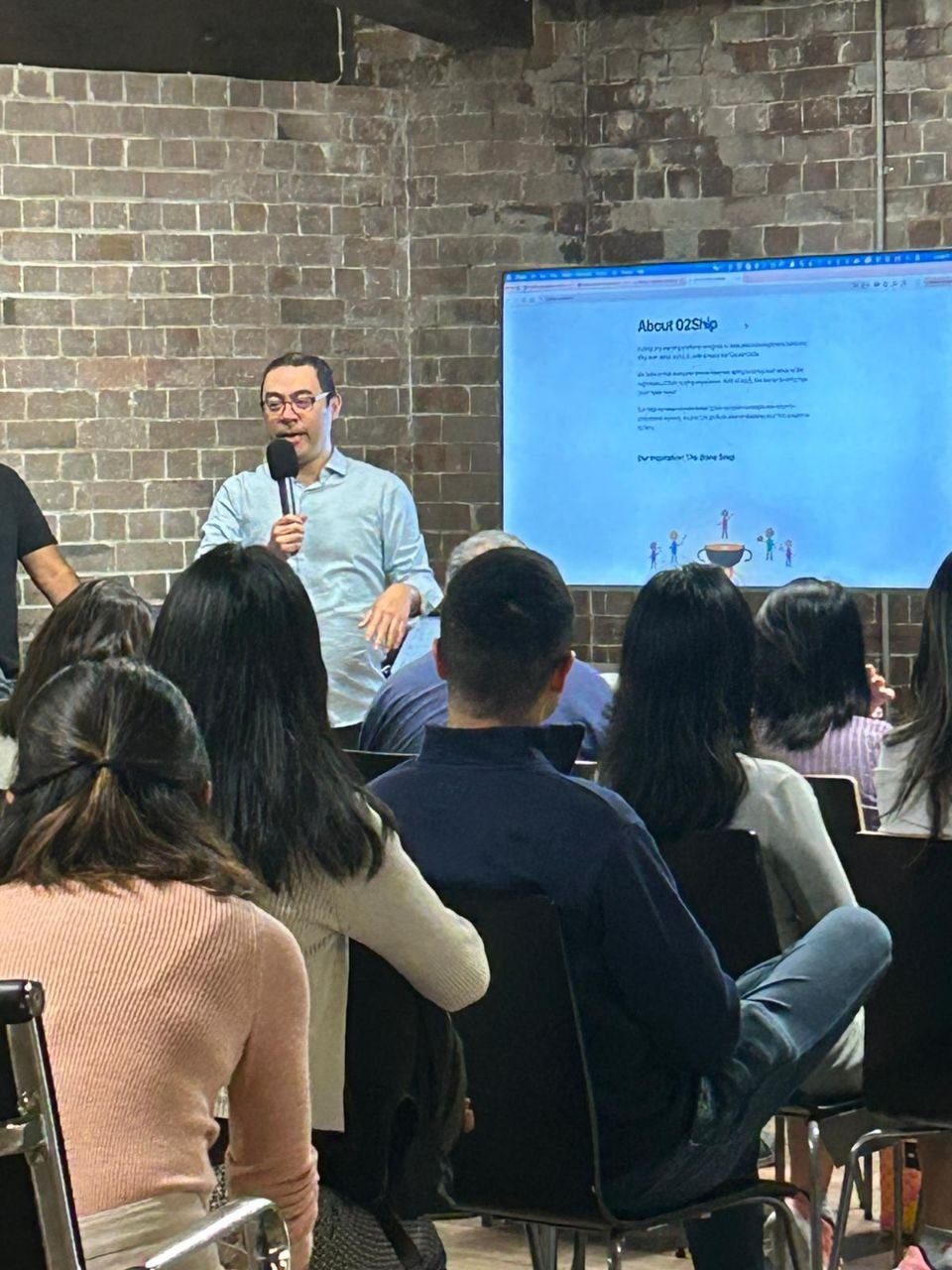
Bob Jiang (02Ship) followed with a live walkthrough of a weekend build: the Lightning Talk Voting tool that powers 02ship.com/vote. Five PRs, one prod incident, and a handful of lessons about which AI tool to reach for at each stage.
The arc of the build:
-
Idea → Hermes brainstorm. Before writing code, Bob ran the idea through Hermes (via the gstack
office-hoursskill). Its job is to kill scope, not help you write. It cut the feature list by ~60% in 10 minutes — dropped ranked-choice voting, Slack integration, and user profiles. The narrowest wedge: "40 people on a phone, 5-minute window, one cookie, three votes." -
First PRD with Claude Code + gstack — failed. Asked to "refine the PRD," Claude Code produced 40 pages, 6 services, WebSockets, Redis streams, 3 new tables. Too complex to build or review. Lesson: Claude Code is a coder. If you ask it to architect, it will happily over-architect.
-
Refine with superpowers + codex review. Switched to the superpowers skill chain —
brainstorming → writing-spec → writing-plans— which locks intent before touching implementation. Got a 6-page PRD, 1 KV store, honest edge-case list. Then ran the PRD throughcodex review(OpenAI's Codex CLI in adversarial mode) for a second pair of eyes. Codex caught three real gaps: "no auth for approvers," "rate limit is per-cookie — trivial to bypass," "what happens when a talk is rejected after a vote?" -
Write plan → execute in a worktree. Plan as a checklist of commits, each small enough to review in one sitting. Git worktree keeps the main checkout clean. The
verification-before-completionskill requires evidence (test output), not vibes, to close a step. -
Code review + E2E — and an E2E trap. Three-lens review: Claude self-review (simplify skill), codex review (adversarial), then a human on the diff. Plus a Playwright E2E covering submit → approve → vote → verify. The trap: the E2E ran against the shared prod KV store. Every CI run left behind
"E2E Speaker 1776673201567"records, drowning out real talks. Eventually deleted the test (PR #69). Rule: E2E against shared prod needs teardown — or kill the test. -
The deploy cliff. Localhost all green → production returns 500 on every submit. The client showed "Please fill in name, title, intro..." even when every field was filled. Root cause: Vercel KV had been deprecated; the store migrated to Upstash, which provisions different env var names.
@vercel/kvreadsKV_REST_API_URL; Upstash providesUPSTASH_REDIS_REST_URL. Firstkv.incr()threw; no try/catch, so a 500 HTML page bubbled to the client, which fell through to its default error text. The fix (PR #66) aliased the env vars at module load and wrapped every voting route in try/catch so real errors reach Vercel logs.
Five lessons from the build
- Start with a scope-killer. Hermes / office-hours before any coder.
- Match the tool to the stage. Claude Code doesn't write PRDs well; superpowers does.
- Always get a second model's eyes. Codex catches what Claude rationalizes.
- "Tests pass" ≠ "prod works." Env vars, secrets, and integrations live outside your repo.
- Make prod errors observable. Try/catch every KV/API call; log with a tag so you get from "prod broke" to a stack trace in 30 seconds.
Bonus rule: never stack PRs on an unmerged feature branch unless you plan to rebase after the base merges. (PR #67 merged into a stale branch and never reached main — which is why PR #68 exists.)
The PRs, all public on the repo:
| PR | Title |
|---|---|
| #65 | feat: community lightning-talk voting tool |
| #66 | fix(voting): Upstash env aliases + route try/catch + clearer errors |
| #67 | feat(vote): read-only results view (merged into stale branch) |
| #68 | feat(vote): read-only results view after voting (reland onto main) |
| #69 | chore(e2e): drop lightning-talk smoke test |
Community Lightning Talks — Now Open for Voting
The last block of the night was dedicated to the community. All six submitted lightning talks were presented live — a quick pitch from each speaker. The voting page is live until the next meetup; pick your top three at 02ship.com/vote:
- Beyond the Demo — Fayner Brack — "AI can build an MVP in a weekend but can't tell you what to do when a real user shows up on Monday."
- pi cloned — Burin Choomnuan — Replicating features of a Claude Code competitor to see how far he can get.
- Partner Management System in 2 weeks — Tony Huang — Building a partner management platform on a two-week deadline.
- Agentic Workbench — Aboo — An open-source workbench for engineers working with agents.
- Next Anthropic — JohnZhou — Investment angle on Anthropic's valuation trajectory and the adjacent opportunities.
- Automating the loan serviceability sheet — Linda Liu — Claude-powered tool that extracts financial data and auto-fills mortgage serviceability calculations.
Top-voted talks get the headline slot at the next meetup. Cast your votes →
Join the Next Meetup — Tuesday, May 19
We're back on Tuesday, May 19, 2026 at Haymarket HQ — same venue, same rhythm: 6:00 PM doors, 6:30–7:30 talks, 7:30–8:30 networking.
Still "not a hype session" — real workflows, real lessons, real examples from people shipping with AI. If you've built something with Claude Code and want a 5-minute slot to share what you learned, apply here.
It's free. Spots fill fast.
See you there.