An AI Board of Directors, the Human Element in AI Design & Harness Engineering — Claude Sydney Meetup — June 16, 2026
An AI Board of Directors, the Human Element in AI Design, and Harness Engineering
TL;DR
- Give each AI agent a clear role (CFO, CMO, CTO) so they disagree and push back, instead of one agent that always agrees.
- Enforce agent guard rails in code, not just prompts. Use read-only access, block destructive queries, and gate risky actions behind approval.
- The human element is the differentiator. AI is an amplifier. A lazy prompt gives generic output.
- Write your taste and judgement into the repo. As one speaker said: "Code is free. Judgment is scarce."
- The next meetup is on Tuesday, July 8. The theme is agent memory and data management, with TiDB.
On Tuesday, June 16, the 02Ship community met again at Haymarket HQ for the June Claude Sydney meetup.
The night had three talks. They covered different angles: how to give AI agents real roles, why the human element still matters in design, and how humans steer agents at scale.
Thanks to Haymarket HQ for hosting us again.
Talk 1: Building an AI Board of Directors — Harshil Siyani
Harshil Siyani built an AI boardroom. You can see his slides here: ai-boardroom-demo.vercel.app.
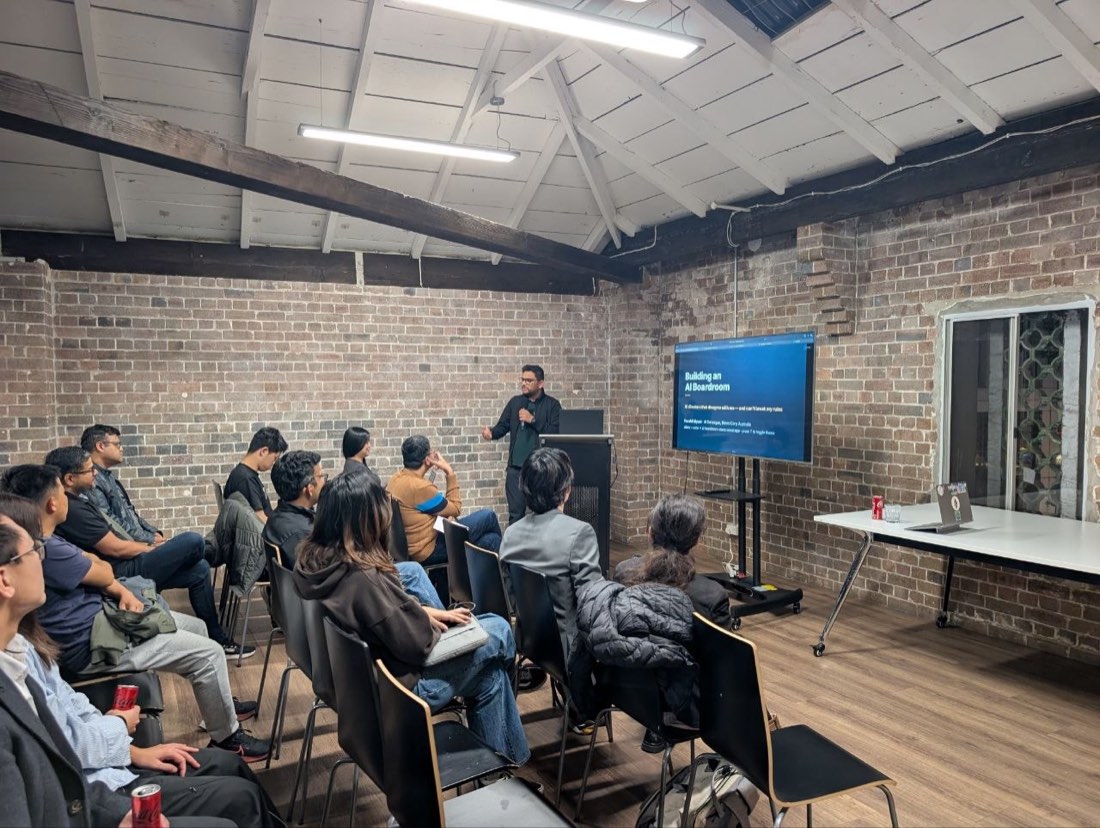
The core idea
Give each AI agent a distinct persona and role. A CFO, a CMO, a CTO. Do not prompt one generalist model and hope it covers everything.
The problem this solves is simple. A solo AI almost always agrees with you. Board members disagree. They push back with real data.
Each agent reads live data
The agents are not just persona prompts. Each one connects to a real data source:
- The CMO pulls Twitter analytics (for example, "you haven't posted in 4 months, 15 views").
- The CFO queries Supabase financials (for example, "8.53% conversion, 11 paid users of 129").
- The CTO reads the GitHub codebase through the GitHub API.
Guard rails live in code, not prompts
Harshil enforced roles at the tool level, not the prompt level:
- The marketing agent has read-only database access.
- The CTO can read the database and GitHub.
- No agent can run destructive queries.
CREATEandDELETEare blocked in code. - Actions that need approval, like scheduling a tweet, are gated by a session approval state.
In a later demo, one agent tried to run a CREATE TABLE query. The tool blocked it and raised an error from the code, not from the model.
The live demo
He asked the board a real question: "Should we build a Teams feature for PromptPerf?"
- The CFO (Victoria) argued against it. Only 11 paid users.
- The CTO noted that it needs a large architecture overhaul.
- The board recommended a manual team plan soft launch at $49 per user.
- An agent created a Linear ticket with full instructions, automatically.
- An agent drafted a Twitter thread to announce the launch. It was held as a draft, not scheduled, because of the guard rails.
All decisions are stored in Supabase. A new session can recall the context from before.
The full production setup
The demo was small. The real setup is bigger:
- 7 board members: product, technical, growth, UX, data/AI, finance, and community.
- Each board member has 3 sub-agents with different angles, like security, UX, and cloud.
- 76 synthetic personas that represent his ideal user base vote on a feature before it enters the backlog.
- Approved features auto-run the next day through Linear's agent pipeline.
He built this in 3 to 4 hours on a Sunday, using Google ADK.
Takeaways
- Force disagreement between agents. Mix models (Claude, Gemini, GPT) for bias diversity.
- Ground opinions in real data, not just persona prompts.
- Enforce roles with code-level tool restrictions, not markdown prompts.
- Only run the relevant agent for each query. Do not fire all agents every time.
Talk 2: The Human Element in AI-Generated Design — Wendy Teo
Wendy Teo spent 10 years in finance. She is a self-taught coder. Now she builds workflow automation for fintech startups.
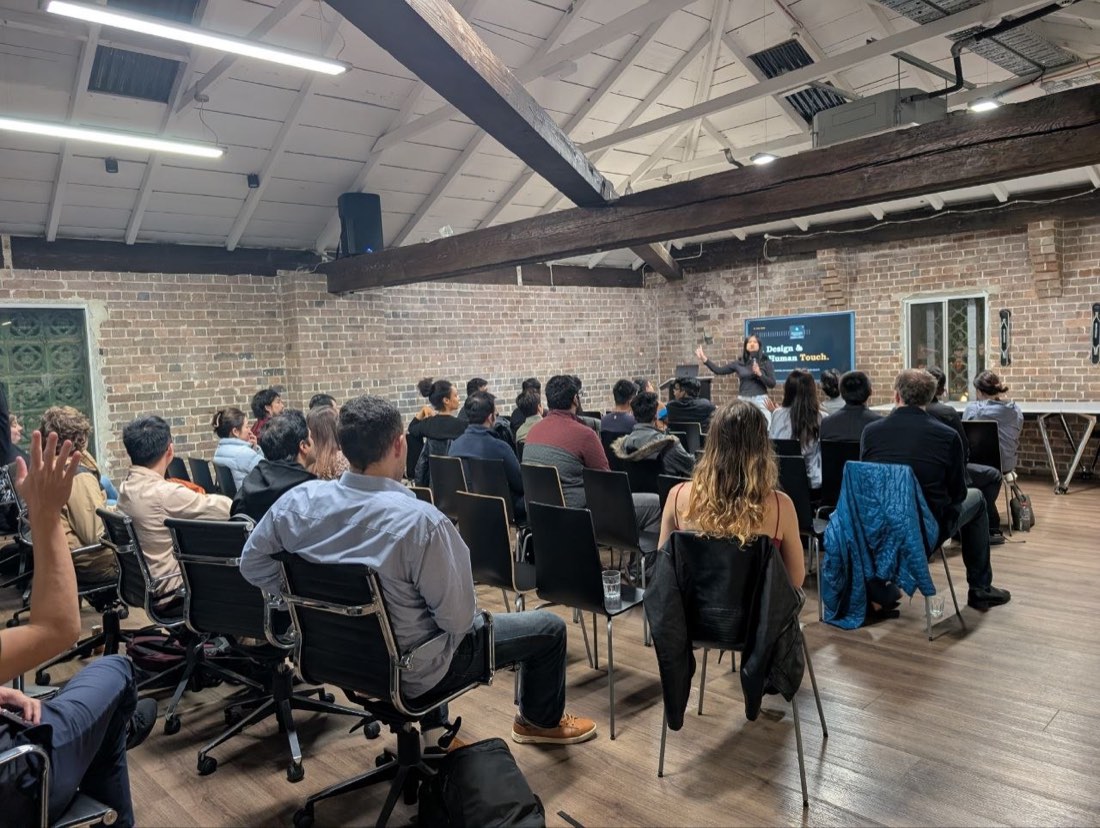
AI flattens empathy
Her main argument: AI flattens empathy and critical thinking. The human element is the differentiator.
When you overuse AI, it erodes your own voice, your judgement, and your ability to connect with an audience. She noted that 20% of YouTube videos are now AI-generated, within just 2 years.
How to spot an AI-generated website
Wendy listed the common tells:
- Default blue buttons, the Inter font, and black text on a cream or neutral background.
- Too much white space, with no design reason.
- Bounce animations that are not needed, often on cards you cannot click.
- Inconsistent button hover states.
- Italic subtitles and titles used for decoration.
- Weird colored side borders. Card boxes with drop shadows that bounce on hover.
- Very basic, forgettable navigation menus.
Lazy prompt, lazy output
A generic prompt returns a generic design and generic follow-up questions. A specific prompt unlocks a specific result.
She showed a demo. The prompt asked for an ocean-depth educational scroll experience for kids. The output was an interactive HTML/CSS/JS page, with creature info, sound, and kid-friendly copy. All from one detailed prompt.
The key idea: AI is an amplifier. It reflects what you give it. So know your own taste, voice, and constraints before you prompt. Do not delegate the thinking.
Talk 3: Harness Engineering — Hemanth Haridas
This was a lightning talk. You can read the slides here.
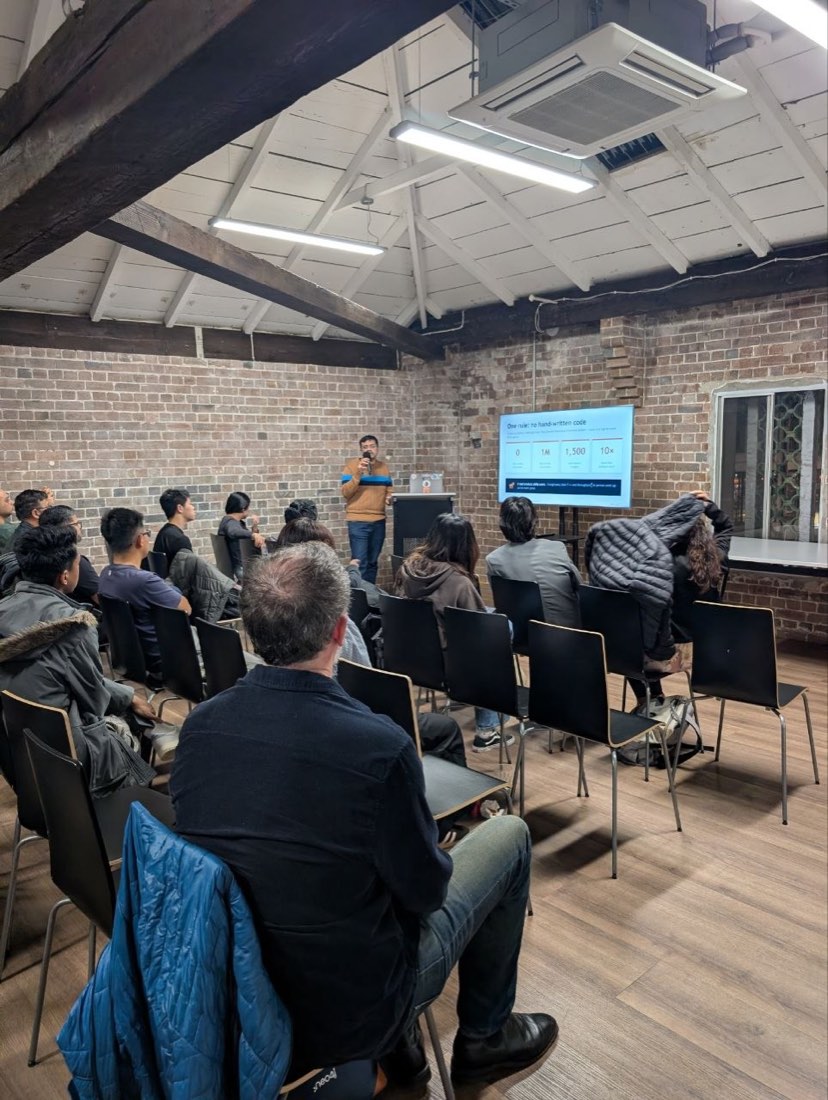
Hemanth shared an OpenAI internal experiment. They started with an empty GitHub repo. Agents wrote all the code:
- 5 months, 1 million lines of code, 1,500 pull requests.
- They shipped about 10x faster. The team grew from 3 to 7 developers, and throughput went up.
- Humans built the harness (the guard rails, the loops, the rails). The agents executed inside it.
He called this "harness engineering". Humans steer, agents pull.
Every agent output is shaped by a prompt. So you should write your taste and instincts into the repo. For example, instead of fixing one missing timeout bug, write a deterministic test that enforces a timeout on every network call, forever.
What this means:
- For engineers: systems thinking and delegation matter more than typing.
- For recruiters: screen for "can this person specify what good looks like?"
- For founders: 3 people shipped 1 million lines in 5 months. The moat was never the code.
His closing line: "Code is free. Judgment is scarce."
Hemanth recently is looking for backend or AI-tools roles. Connect with him on LinkedIn.
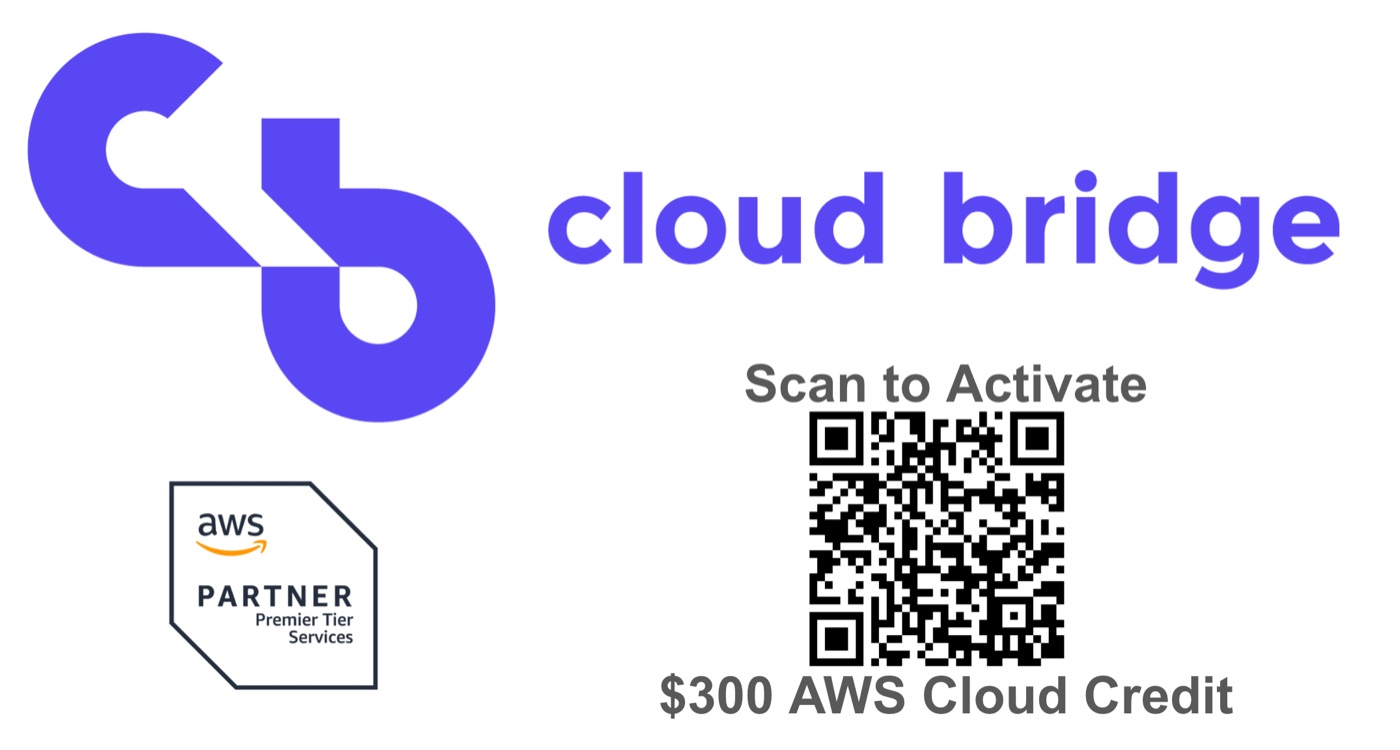
Thanks to Our Sponsor: CloudBridge
This meetup was sponsored by CloudBridge, an AWS Premier Tier Services Partner. They are offering $300 in AWS cloud credits to the community. Scan the QR code to claim them.
Join the Next Meetup
The next meetup is on Tuesday, July 8. The theme is agent memory and data management. TiDB will present on memory as a Claude memory and data layer.
It is free. Spots are limited.
Register for the July 8 meetup on Luma
Get Involved
Want to speak at a future meetup, sponsor an event, or help shape the community? Get involved with 02Ship →
See you there.