cmux, Multi-Agent Claude Fleets & Claude Code as an Autonomous CI Teammate — Claude Sydney Meetup — May 19, 2026
cmux, Multi-Agent Claude Fleets & Claude Code as an Autonomous CI Teammate
TL;DR
- Replace "endless approval loops" with structure — a clear DAG plan, not blind trust in the agent.
- Use isolated git worktrees so parallel agents do not edit the same files.
- cmux gives Claude dynamic terminals, an embedded browser, and a CLI — enough to drive a real workflow.
- Keep each agent's context under about 60k tokens. Quality drops fast after that.
- Wire Claude Code into GitHub Actions CI to review PRs, fix CI failures, and resolve merge conflicts.
On Tuesday, May 19, the 02Ship community met again at Haymarket HQ (Level 2, 63 Dixon St, Haymarket) for the May Claude Sydney meetup.
The topic of the night was multi-agent orchestration. How do you let many Claude agents work together to ship real code, without you checking every step?
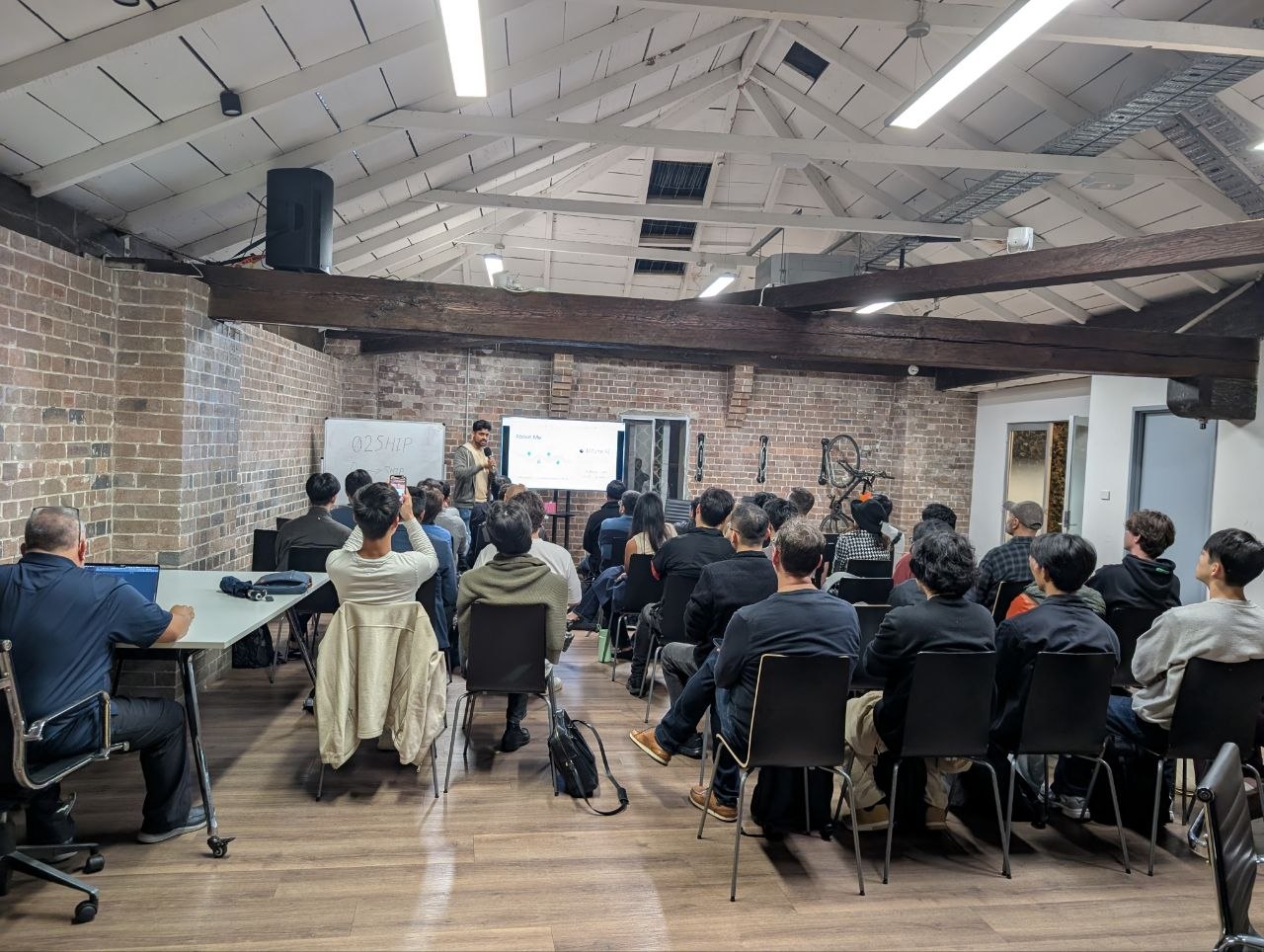
Thanks to Haymarket HQ for hosting us again.
Talk 1: Claude Conducting Claude — Sharat Madanapalli (InTune AI)
Sharat Madanapalli is the founder of InTune AI. He has 10+ years in ML and a PhD from UNSW. His company helps businesses adopt AI. Clients include Virgin, Lifeline, nuix, AVLAW, and Canopus. They help on three things: find AI opportunities, train people on tools, and build custom solutions.
His talk was called "Claude Conducting Claude — Working In Tune with AI".
The Agent Paradox
Sharat started with the problem. Opus 4.5 made long-running AI agents possible. But the experience was still bad because of endless approval loops. Every small step needs a "yes" from the user. Two things happen:
- Some users are scared and approve nothing.
- Some users just click "yes" without reading.
Both are bad. If you skip the approvals, the agent runs out of context and gets dumb. So Sharat wanted a clear structure for agent work, not blind trust.
From linear to DAG
Before AI, one developer worked in a line: Plan → Build → Verify → Review. But AI can do more than one task at a time.
Sharat showed a Directed Acyclic Graph (DAG) model. The plan splits into many tasks. The tasks run in parallel. Then they merge. This is how human teams worked before AI — a PM plans, then engineers work in parallel on frontend, backend, and cloud.
The hard part is the "interface contract" between tasks. If task A and task B agree on the contract first, they can work alone.
cmux: the AI orchestration workbench
To run this DAG, Sharat uses cmux. It is a native macOS terminal made for agent work. cmux gives the orchestrator:
- Dynamic terminals and panes
- An embedded browser that uses token-efficient snapshots instead of full HTML
- Real-time notifications
- A CLI you can script
The idea is simple: if Claude can drive the terminal, Claude can work like a real team.
In Sharat's setup, Claude Code (or Codex) uses cmux to:
- Run the DAG plan
- Spawn worker agents in isolated git worktrees
- Launch containers and read logs
- Open browser panes to verify behaviour
- Review code changes in a Codex pane
Demo: shipping a feature with a fleet of Claudes
The live demo shipped a real feature: a historical-context capability for a network traffic-spike detection agent.
The workflow was:
- An OpenSpec-style proposal file described the feature.
- A DAG.md file defined the parallel plan:
- Layer 0: interface definition (the contract)
- Wave 1: Schema (A), Agent logic (B), Database (C), Frontend (D) — each in its own worktree
- Merge and review at the end
- Overnight execution with a main orchestrator agent.
- Morning result: a complete PR with passing tests.
Things he learned
A few practical notes from Sharat:
- He uses Claude Sonnet as the worker model, not Claude Computer Use.
- Worktree isolation is very important. Without it, agents will edit the same files and break each other.
- Use isolated agent instances, not sub-agents. Sub-agents have real limits.
- Keep each agent's context under about 60k tokens. After that, quality drops fast.
- The patterns are still new. He is watching OpenAI Symphony and Sandcastle.
- For cost, he runs the fleet at off-peak hours to get more from API limits.
Talk 2: Claude Code as an Autonomous CI Teammate — Fayner (Readplace)
Fayner is a solo founder. She builds Readplace. She showed how she wires Claude Code into the GitHub Actions CI pipeline as an autonomous agent.
In her setup, Claude Code automatically:
- Reviews every PR
- Fixes CI failures
- Resolves merge conflicts
- Applies review feedback
Because the boring CI work runs by itself, Fayner can focus on architecture and product.
She also gave a quick tour of how Readplace works end-to-end. Then she showed a recent fix: PDF OCR now fans out to one Lambda per page. Before this fix, large PDFs would time out one single Lambda function. With one Lambda per page, the work runs in parallel and finishes much faster.
She also talked briefly about canary-based monitoring for deployed agents, but did not go deep.
She ended with Q&A. Two questions came up many times:
- How do you split tasks so AI agents can work on them well?
- Why does architecture and design judgement still matter when AI can write the code?
Her answer to the second one: many founders without architecture background try to build complex systems with AI, and then hit a wall. AI writes code, but you still need to design the system.
Both talks shared one message: AI agents are powerful, but the structure you give them — interface contracts, isolated workspaces, clear review gates — decides if the result is good or messy.
Community Shout-Outs (Open Mic)
Three community members shared their projects during the open mic:
- Bradley — a software development framework with an AI harness, to keep agents on track.
- Burin — a lightweight markdown presentation tool, for people who like writing markdown more than using slide software.
- Joseph — a game built by a developer with no game-dev experience, which shows how AI lets you enter a new domain quickly.
If you want to share next time, just add your name to the open mic list when you arrive.
Join the Next Meetup
The next meetup is on Tuesday, June 16 at Haymarket HQ (Level 2, 63 Dixon St, Haymarket). Same time as before (6:00 – 8:30 PM).
It is free. Spots are limited.
Register for the June 16 meetup on Luma
Get Involved
Want to speak at a future meetup, sponsor an event, or help shape the community? Get involved with 02Ship →
See you there.